
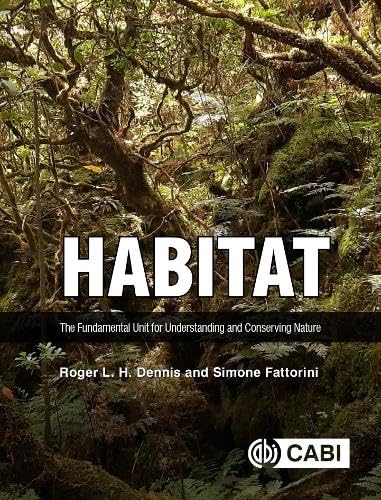
Habitat: The Fundamental Unit for Understanding and Conserving Nature
Product details
| Management number | 237179092 | Release Date | 2026/07/10 | List Price | US$61.41 | Model Number | 237179092 | ||
|---|---|---|---|---|---|---|---|---|---|
| Category | |||||||||
Habitat is the fundamental unit for understanding species ecology and preserving biodiversity; it has always had a variety of meanings often not explicitly defined. This important book focuses on the two main uses of the term and their importance for nature conservation. The first, traditional usage (TH), is that of terrestrial, aquatic or aerial spatial units which can be denoted by the species they host, with associated trophic relationships and interdependencies. The second, termed resource-based habitat (RBH), focuses on any one species' habitat. These RBHs are rarely limited to one space but are defined by the intersection of appropriate resources and suitable conditions. Since the ability of individuals to exploit resources is influenced by their own unique combination of traits, the RBH is spatially and temporally variable. The book explores how communities are structured, how species and individuals interact (niches, guilds, food webs, etc.), and how biodiversity changes over space and time. Typically, a location distinguished by specific attributes (TH; a meadow, a wood, a field, etc.) has few common species, but many rare ones and the book explores this long challenging conundrum. The TH usage has immense importance and implications for maintaining wildlife. Because of the variety of the ecological characteristics of different species, the study of them in distinctive spatial units (a lake, a moor, the seashore, the lower atmosphere, etc.) requires special methods in each case to determine their conservation status. The RBH is critical for understanding the factors necessary for the maintenance of 'focal' species, regarded as key or rare elements of ecosystems. The book explores the different ways in which such species are maintained: i.e., their traits, defining their ecological and behavioural uniqueness, morphology, physiology, biochemistry, and the resources-and conditions-on which they depend. It also examines how, as specialists or generalists, species are placed in the trophic hierarchy, how they fit into their communities and influence the evolution (or demise) of other species. Ultimately, the book investigates how best to conserve biodiversity. Read more
Bestseller ranking
Wildlife



Customers who viewed this product also viewed
Boston Bruins Womens

Correction of product information
If you notice any omissions or errors in the product information on this page, please use the correction request form below.
Correction Request Form